

Early 20ᵗʰ century decorative stained glass
Around 1900, the development of exhibitions and art fairs where glass artists can now, like painters and sculptors, present their creations, contributed to the popularization of stained glass. In these works made for exhibition purposes, artists can freely demonstrate their talent without any iconographic constraints. Albert and Maxime Échivard exhibited several stained-glass works in Le Mans and at the Salon des Artistes Français in Paris.
The splendid Dame à la Rose created by Maxime Échivard (1913) as an exhibition piece, demonstrates the use, in the early 20ᵗʰ century, of a wide range of industrial glass with varied textures and levels of transparency. The sensuality that emanates from this stained-glass window is partly due to these new lighting effects.
In the early 20ᵗʰ century, the decorative movement known as Art Nouveau sweeps across Europe. This new aesthetic, with its curved lines inspired by the plant world, leaves its mark on architecture as well as on all decorative arts (furniture, ironwork, ceramics, etc.) and gives a prominent place to stained glass.
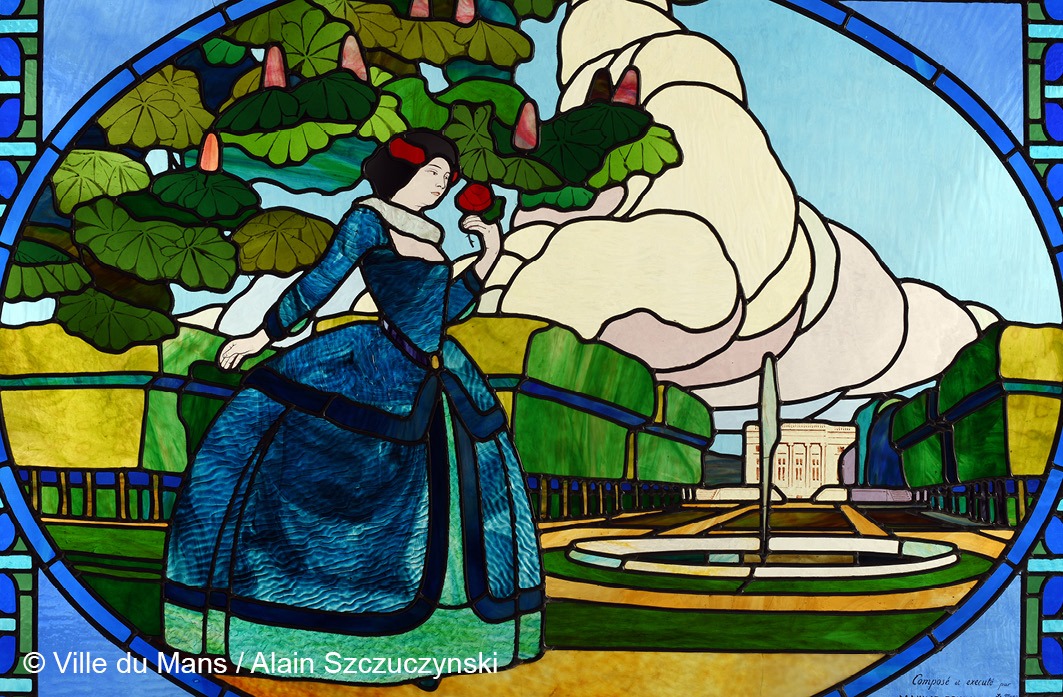
Architects in Le Mans now offer their clients the option of incorporating fashionable decorative stained-glass windows into their apartment and mansion projects. The French 1905 law separating Church and State also contributes to the development of secular stained glass. Master glassmakers, who can no longer make a living solely from commissions for religious stained glass, have to open up to a new clientele.
Between 1905 and 1920, the important Laval-based master glassmaker Auguste Alleaume completed several commissions in the Sarthe region, including for the famous Chappée foundry in Le Mans. Alleaume also created stained-glass windows for the home of industrialist Max Térouanne, which are among the finest examples of Art Nouveau in Le Mans.
With the spread of urbanization and the growth of commerce at the beginning of the 20ᵗʰ century, public spaces also integrate the trend for stained glass. Department stores, cafés, hotels, and train stations are adorned with spectacular glass bays and ceilings demonstrating the union of art and industry. In Le Mans for example, a great stained-glass window is designed in 1925 for the stairwell in the shop Aux Dames de France – of which you can find a replica in the exhibition.
The decorative movement and aesthetic also influenced religious stained-glass art in the first half of the 20ᵗʰ century. Several examples of church decoration in the Sarthe region reflect a desire to break with the conservative trends of the 19ᵗʰ century. Beautiful examples of this are the windows designed in 1903 by Albert Maignan at Parcé-sur-Sarthe and those designed in the early 1930s by Maurice Denis and his pupils at the abbey of Solesmes.