

Stained glass and the two world wars
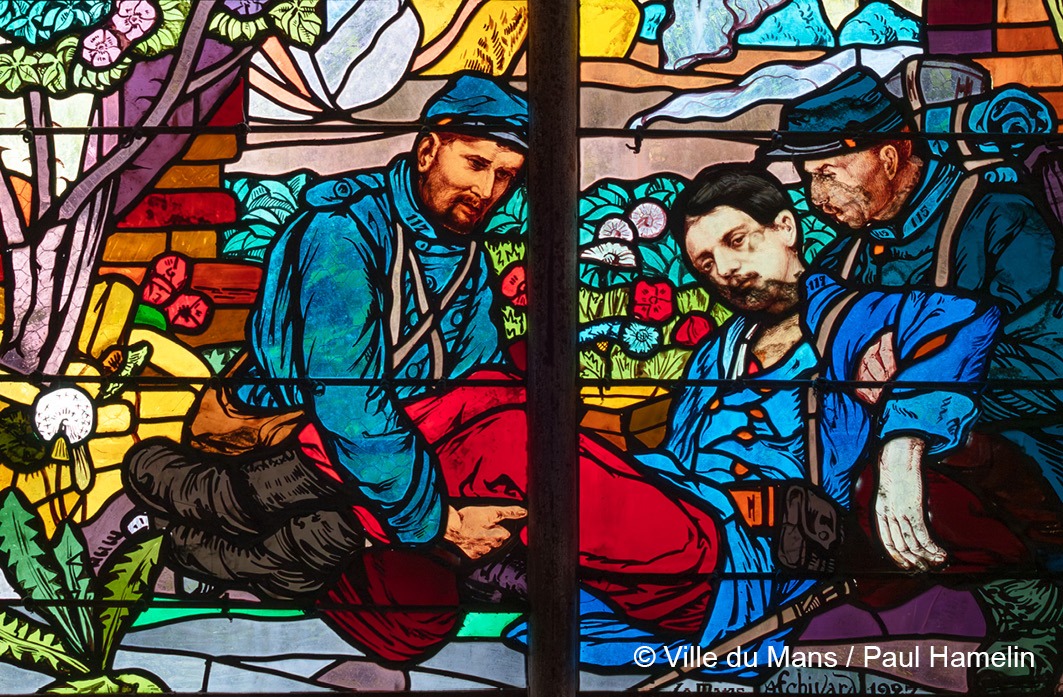
Alongside war memorials, church stained-glass windows become, in the 1920s, a primary medium for commemorating World War I. Depictions of fallen soldiers are very commonly found in French stained-glass windows of this period. In Sarthe, a great number of these are designed by Albert Échivard, whose son Maxime died at war in 1914.
These representations are often accompanied by the protective figure of Joan of Arc, who becomes a symbol of the newly freed nation. An entire chapel is dedicated to her in Le Mans Cathedral, to thank her for having spared the city from the destruction of World War I. Five large stained glass windows are designed in 1927 by Henry Morin, Julien Chappée, and Albert Échivard in a deliberately modern style. These extraordinary stained glass windows depict the main phases of the national heroine’s epic life, while incorporating surprising representations of soldiers from the Great War.
In the aftermath of World War II, Le Mans experiences a period of active church construction and stained-glass commissions thanks to financial support provided by the historic twinning with the city of Paderborn in Germany. The 1950s reconstruction projects integrate the cubist and expressionist stained glass windows of the famous Parisian artist Max Ingrand. He designed 42 windows in the church of Notre-Dame du Pré in Le Mans between 1948 and 1954.
The dalle de verre technique is the preferred choice for the windows of new concrete churches built in the 1950s and 1960s. There are numerous examples in Le Mans, such as in the churches of Saint-Liboire and Saint-Aldric. The technique consists in using thick slabs of coloured glass that are chipped to create lighting effects. The slabs are held together by reinforced concrete (instead of the lead used in the traditional stained-glass technique). Gabriel Loire is, on a national scale, one of the pioneers of the dalle de verre technique which he used to decorate a number of buildings in and around Le Mans.